
the poems
Memory spoken softly.
Grief given language.
Ordinary moments made luminous.
at it's heart
Nature.
Music.
Love.
Loss.
The quiet work of healing.
new & forthcoming
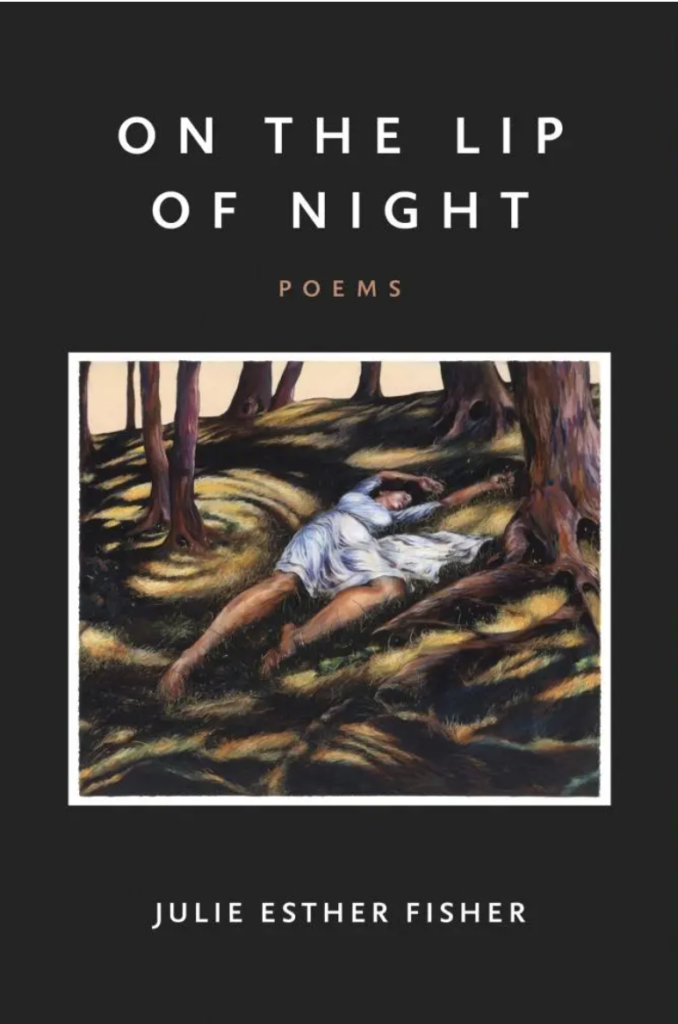
Twenty-six poems move through landscapes of family, memory, grief, and recovery, finding beauty alongside sorrow and hope alongside loss. With lyricism, wit, and an unwavering attentiveness to the natural world, Julie Esther Fisher explores the lives we inherit and the grace that allows us to begin again. Inspired by themes of nature, music, and enduring connection, the collection invites readers into moments that are both deeply personal and profoundly shared.
Some grief cannot be undone.
Some beauty is found only by learning to carry it.
reviews & PRAISE FOR JULIE ESTHER FISHER
Julie Esther Fisher echoes no one; her lines startle and boundaries may only reveal themselves when dissolving. Within a single poem one can move from praise for tree, love, or creature, then swerve within a shadowy surrealism to the un-secreting of trauma: “Is there a chance that an eyelash is still someone?” A discreet post-mortem. There is a cast of elegant iridescence over these poems so that innocence ruptured, any breath of menace or what may pick away at the seams of shame, lift toward the reader with an imperative of hard-earned defiance! And yet the poems of On the Lip of Night have a tensile beauty which draws you in, for there is also affection and praise, humor, wit and the intent surprises of poetry itself!
— Jody (Pamela) Stewart
author of This Momentary World
Transformations eerie and magical occur throughout Julie Esther Fisher’s extraordinary collection of poems, On the Lip of Night. A man becomes an ear, children turn into musical instruments, a sleeper is transformed into a deer. A poem’s speaker changes places with a scarecrow, another asks what am I next to be? Memory itself turns physical and lodges in the body; tides and hemlines rise and fall. The poems’ speakers seek to make sense of a chaotic reality in which parents can turn predatory, where children, defenseless against inexplicable cruelties, plan their escape. Form has become mutable, held together by breath and memory. Only now and then there is something to trust, like the hour of milk / when sweetness / instinctive in both / called lip to dipper / and they tasted brightness. With exact observation and incandescent language the poet follows a flickering trail of images and voices, painful and tender, until she can say, This is my music. / This is exactly how I mean it.
— Martha McCollough
author of Trash Witch and I woke up for this
Julie Esther Fisher’s poems may comprise a ‘small act of redemption,’ but small gestures in On the Lip of Night have looming implications. There are restless memories and unflinching assessments — all bristling with intelligence and, ultimately, full acceptance of the strangeness of experience.
— Ron Slate
author of Joy Ride
BOOK DETAILS
Publisher
Finishing Line Press
Publication
August 2026
Format
Paperback
Genre
Poetry
READ AN EXCERPT
At the Hour of Milk
When the barn lit up for the very first time
the cows
in their stanchions
gave no milk
The galvanized buckets
deep black holes
anthracitic as the ravens on the fence
five in a row
a line of them reaching the farm
like the new electricity
They appeared that evening
hearing light
motionless
voiceless
as though whittled
of coal
Beyond
in the
eerie reach of the new light
the cows
trembled
the channels for their filth
all full
slow moving
a river of yesterday
Above, the swinging of
glowing filaments
Yesterday’s teats squinched by dawn-pink fingers
polished
into buckets
Galvanized
He always loved that word
Progress
Indestructability
Cheek to the warm
their steam in the bucket
their milk hides
His boy used to join him in the barn
at the hour of milk
when sweetness
instinctive in both
called lip to dipper
and they tasted brightness
Beneath the new light
he counted the cows
mouthed their names
Jenny Bertha Plum
Clover shifted her square and jutting hind
with its pendulous bag
hiding in her tender place
the righteous milk
Bone Mountain
When does loneliness end? They tell me
not to ask this question until I break
my legs
on the mountain climb
I look up at the monastery
an atlas bone holding up
the heavens
I promise to continue my
weight training here. They accept me
on condition that it isn’t
wait training
that I engage in the purple robes of
the momentary
the bells inside my chest
the thin air
that might kill me
As I am in my nonage, others are
in their dotage
already half fused into the mountain’s
spine
I tell them what loneliness feels like
an evil tenderness
What I hear in reply
snorts of amusement
someone sneezing out my
my poor understanding
The unbroken goes on up here
in this, my hobbled courtship
Which bone in my body is the
most useful? This I will sacrifice
give to the gods
a humerus, say, or
better yet
a femur
that might give faith a leg
I don’t understand loneliness
I should substitute
fear
or perhaps reluctance
Even try for extreme ravenous hunger
or senseless joy
I pass through the halls at night
and wonder
will this wind ever take me home
This ache
I can’t believe
it’s me
While I weight it out
The gossip I hear
the clack of so many femur bones buried
in the mountain
How should I forgive you,
as the acorn forgives the oak,
the aspen her own trembling?
Perhaps as the weasel
forgives its reputation,
or the interrupted fern
its own terrible gaps?
Should I as the ring-necked pheasant
forgives her noose,
or the mourning dove
her same old tune?
What of the whirligig beetle
consigned to swim in circles,
or the phantom crane fly
too slender to cast a shadow?
Consider the question mark moth
who forgives the missing answer,
the water strider for what
only a true savior can do.
I know what they say about
the promise of forgiveness,
so I try again
as the snow
forgives its own falling,
the Indian pipes
their own nakedness,
the wild grape
its strangling ways.
I try as I think
the acorn must the oak,
knowing its own
impossible odds,
willing to forgive in advance
every imaginable growing pain
on the journey to towering.